

“PI/PO to SAP Integration Suite: Why Simply Rebuilding Every Interface Is a Mistake”
Learn how to approach SAP PI/PO to Integration Suite migration through interface discovery, rationalisation, standard content and modern cloud integration patterns.
Migrating from SAP Process Integration/Process Orchestration (PI/PO) to SAP Integration Suite is often treated like moving into a brand-new, modern house: pack up every single box from the basement, carry it over, and unpack it in the new living room.
If you take a strict 1:1 "lift and shift" approach to your SAP migration, you are directly importing 15 to 20 years of accumulated technical debt into a pay-for-performance cloud architecture. Simply rebuilding every existing interface isn't just inefficient—it’s an expensive strategic mistake that undermines the entire rationale for moving to the cloud.
Here is an expanded dive into why a direct rebuild fails, how it cripples your long-term roadmap, and how to execute a modern, rationalized migration instead.
The Hidden Trap of the 1:1 Rebuild
SAP PI/PO was designed around a late-1990s and early-2000s architectural mindset: dual-stack systems, on-premise footprint, scheduled batch transfers, and heavy point-to-point orchestration. Over two decades, enterprise landscapes naturally accumulated redundant interfaces, obsolete FTP polling loops, legacy custom ABAP routines, and point-to-point integrations for systems long since decommissioned.
Rebuilding all of this line-by-line yields four immediate operational and financial traps:
-
Paying to Rebuild Ghost Interfaces: In many mature PI/PO landscapes, interface inventories contain redundant, inactive or obsolete integrations accumulated over years of business and system changes. Spending developer hours recreating interfaces that haven't processed a message since 2021 burns budget on zero real-world value.
-
Misaligned Cloud Cost Models: On-premise PI/PO costs were largely fixed based on server size.Unnecessary interfaces can increase operational complexity, monitoring effort, integration processing and, depending on the customer's commercial model and usage, consumption-related cost. Carrying over heavy, stateful dual-stack polling patterns directly inflates your cloud bill.
-
Preserving Technical Debt and Legacy Code: Legacy PI/PO flows frequently depend on proprietary Java mappings, complex ccBPM (cross-component Business Process Management), and custom ABAP function modules. Blindly porting these requires complex workarounds in Cloud Integration, creating fragile, unmaintainable iFlows.
-
Missed Modernization Opportunities: Modern enterprise architecture has shifted toward API-led connectivity, event-driven architecture (EDA), and standard pre-packaged content. Rebuilding monolithic file transfers leaves your landscape stuck in an asynchronous batch processing era.
Detailed Comparison: 1:1 Rebuild vs. Architectural Modernization
| Architectural Dimension | 1:1 Rebuild Strategy | Modernization & Rationalization Strategy |
|---|---|---|
| Primary Goal | Feature parity and rapid system shutdown | Architectural cleanup, agilizing, and cost optimization |
| Development Approach | Manual rebuilds or direct migration tool lifts | Maximize pre-packaged content from SAP Business Accelerator Hub |
| Integration Pattern | Point-to-point, scheduled batch processing | API-led, event-driven (EDA), publish-subscribe |
| System Coupling | Tight coupling with custom payload structures | Loose coupling with standardized REST/OData interfaces |
| Execution Overhead | Heavy, stateful orchestrations preserved | Stateless, distributed, lightweight cloud iFlows |
| Long-Term Cost | High runtime consumption and maintenance overhead | Optimized message usage, zero cost on dead flows |
The 4-Step Strategy: Rationalize Before You Build
Instead of treating the migration as a developer-driven coding sprint, run it as a comprehensive architectural refresh.
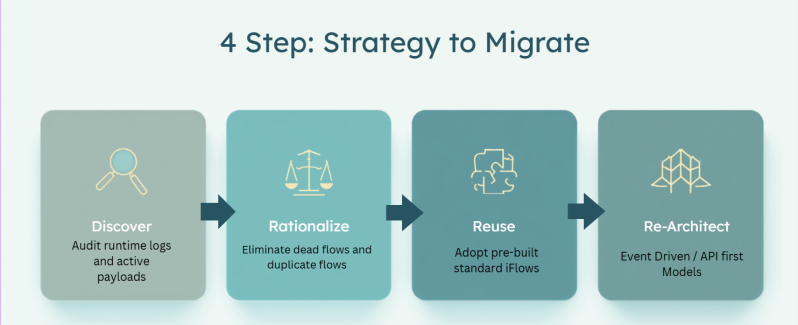
1. Data-Driven Discovery and Runtime Auditing
Never rely solely on configuration documentation—it is almost always outdated. Run runtime usage logs on your PI/PO environment over a full 12-to-18-month cycle. This captures annual finance runs, quarterly tax filings, and seasonal supply chain peaks.
-
Identify interfaces with zero total executions.
-
Flag interfaces with low execution counts that can be combined or handled on-demand.
-
Audit payload sizes to spot unnecessarily massive file transfers that can be chunked or streamed.
2. Rationalize, Consolidate, and Eliminate
Categorize your existing inventory into three clean buckets: Retire, Consolidate, or Replatform.
-
If 15 separate file interfaces send master data changes to different downstream systems, consolidate them into a single Publish-Subscribe model using SAP Advanced Event Mesh.
-
Replace multiple single-target file drops with a unified payload broadcast, cutting 15 maintenance points down to one.
3. Maximize Pre-Packaged Content
Before writing custom Groovy scripts or graphical mappings, check the SAP Business Accelerator Hub. SAP provides hundreds of standard, pre-packaged integration flows (iFlows) for S/4HANA, SuccessFactors, Ariba, Salesforce, and ServiceNow.
-
Standardizing on pre-packaged content offloads interface maintenance back to SAP during system upgrades.
-
Custom logic should only be built as explicit extensions, keeping the core integration clean.
4. Re-Architect for Cloud-Native Patterns
Transform rigid legacy mechanics into modern cloud architectures:
-
SFTP Batch Drops >> Evaluate API/Event-Based Alternatives Where Business and Technical Requirements Allow: Replace flat file generation with OData or RESTful webhooks that trigger instantly on event changes.
-
ccBPM Processes >> Assess Whether Process Automation or Integration Services Are Better Suited to the Business Process: Move complex, long-running business orchestrations out of the integration runtime and into dedicated process automation engines.
-
Custom ABAP/Java Code >> Native Cloud Functions: Replace obsolete custom Java classes with lightweight Groovy scripts, modern JavaScript, or standard Cloud Integration palette steps.
Concrete Real-World Impact
Consider a mid-sized hypothetical enterprise running 350 active interfaces on SAP PO:
-
Under a 1:1 Rebuild Strategy: The team spends time and money migrating all 350 interfaces. They bring over 80 dead flows, 40 duplicate mapping patterns, and dozens of custom Java routines. Total migration timeline inflates, and cloud runtime costs are higher from day one due to persistent polling loops.
-
Under a Rationalized Strategy: The audit reveals 90 dead interfaces (retired immediately) and 60 redundant file drops (consolidated into 10 event-driven topics). Another 100 flows match standard SAP Business Accelerator Hub content. The team only needs to manually design and build 90 custom, optimized iFlows.
The Bottom Line
Migrating to SAP Integration Suite isn't an infrastructure maintenance tax; it is your best opportunity in a decade to clean house. By rationalizing your landscape first, you build a leaner, faster, and far more cost-effective integration layer that genuinely accelerates your digital transformation rather than anchoring it to legacy patterns.
Is your organisation planning a PI/PO to SAP Integration Suite migration?
Before rebuilding hundreds of interfaces, consider assessing what should be retired, consolidated, replatformed or redesigned.
Cloud Intelytics Solutions can help organisations assess their existing integration landscape and develop a pragmatic migration roadmap covering:
- PI/PO interface discovery and assessment
- Interface rationalisation
- SAP Integration Suite migration planning
- API and event-driven architecture
- SAP Business Accelerator Hub assessment
- Integration architecture and design
- Migration effort estimation
Talk to Cloud Intelytics Solutions about your SAP integration landscape.
Our Perspective
A successful PI/PO migration isn't measured by how quickly an organisation reproduces its existing interfaces. It's measured by how effectively the organisation uses the migration to simplify, modernise and future-proof its integration landscape.
Cloud Intelytics Solutions
SAP Integration | SAP BTP | Data & Analytics